I have* finally* finished my most difficult sock pattern to date--for myself--so I am eager to whip out some quick baby things. What do we need more of, socks or hats? Or do we know yet?
Friday, June 20, 2014

Monday, June 16, 2014
another sock pattern
I was skimming entries on the Ravelry group Fans of afghans for Afghans and stumbled across a nice-looking baby sock. This one uses a light worsted, and the ribbing helps it stay on -- it is the Ribbed Far-Away Baby Socks pattern, which made its debut on this very blog in 2008.
I will post a picture as soon as I have made a pair -- or you can wander over to Ravelry and take a look. A total of 383 projects have been posted there.
I will post a picture as soon as I have made a pair -- or you can wander over to Ravelry and take a look. A total of 383 projects have been posted there.
Friday, June 13, 2014
June baby shower: a quick hat
Happy Friday the 13th!
We are almost halfway through June, which means we're almost halfway through the available knitting days for the baby shower. Here is a very speedy hat, in case you thought you didn't have time. (Hate double-pointed needles? I tell you how to knit it flat at the end.)
I tend to knit very plain things for afghans for Afghans -- not because I don't think the Afghan kids aren't worthy of my "best," but because by doing that I can finish more things, so more kids get something warm. This hat is as plain as it gets.
I am starting one now, and will add the picture later today -- it goes that fast.
.JPG) edited to add this picture (the hat is actually a beautiful clear red, but I haven't been able to get the camera to agree)
edited to add this picture (the hat is actually a beautiful clear red, but I haven't been able to get the camera to agree)
Worsted weight rollbrim baby hat
Materials: 1 ball worsted weight yarn such as Cascade 220, Galway, or Paton's Classic Merino (will make more than one hat)
double-pointed needles of size needed to get 5 stitches per inch (20 sts/10 cm)
edited to add: the yarn I picked out of the odds & ends box was a little thinner and knit up at 6 sts/inch, giving me a hat that's just about 11 inches around, perfect for a newborn. I wrote the pattern to make a hat a little larger, so it will fit for longer. Remember -- these babies are not going home to piles and piles of new clothes, so the longer something lasts, the better.
Cast on 64 stitches. Join to knit in the round, being careful not to twist.
Work in stockinette (knit every round) until hat measures 5 inches (12.5 cm) from cast-on edge.
Work crown decreases:
Rnd 1: *k6, k2 tog,* repeat from * to * around (56 sts remain)
Rnd 2: knit
Rnd 3:*k5, k2 tog,* repeat from * to * around (48 sts remain)
Rnd 4: knit
Rnd 5: *k4, k2 tog,* repeat from * to * around (40 sts remain)
Rnd 6: knit
Rnd 7: *k3, k2 tog,* repeat from * to * around (32 sts remain)
Rnd 8: *k2, k2 tog,* repeat from * to * around (24 sts remain)
Rnd 9: *k1, k2 tog,* repeat from * to * around (16 sts remain)
Rnd 10: k2 tog all the way around (8 sts remain)
Break yarn and thread through the remaining 8 stitches, drawing thread tight. Pull yarn to the inside of the hat through the center of those stitches. Weave in ends.
To work flat: Follow instructions as written, EXCEPT work stockinette as knit one row, purl one row. When you get to the crown decreases, work rows 2, 4, and 6 as purl rows. Work decrease rows 8 and 10 on the purl side, as purl stitches. Break the yarn, leaving a tail long enough to sew up the seam. Draw the yarn through the remaining 8 stitches, and then sew a flat seam to finish the hat. Use mattress stitch or a whip stitch -- something that will leave as little bulk as possible, to make it more comfortable.
Want to control how far the rollbrim rolls? Here are two ways to do that:
(1) work the first 6 rows on needles one size smaller, or
(2) Work 6 rows, then insert a garter ridge as follows:
(a) if working in the round, purl 1 round
(b) if working flat, knit the 7th row instead of purling it. Then return to stockinette.
We are almost halfway through June, which means we're almost halfway through the available knitting days for the baby shower. Here is a very speedy hat, in case you thought you didn't have time. (Hate double-pointed needles? I tell you how to knit it flat at the end.)
I tend to knit very plain things for afghans for Afghans -- not because I don't think the Afghan kids aren't worthy of my "best," but because by doing that I can finish more things, so more kids get something warm. This hat is as plain as it gets.
I am starting one now, and will add the picture later today -- it goes that fast.
Worsted weight rollbrim baby hat
Materials: 1 ball worsted weight yarn such as Cascade 220, Galway, or Paton's Classic Merino (will make more than one hat)
double-pointed needles of size needed to get 5 stitches per inch (20 sts/10 cm)
edited to add: the yarn I picked out of the odds & ends box was a little thinner and knit up at 6 sts/inch, giving me a hat that's just about 11 inches around, perfect for a newborn. I wrote the pattern to make a hat a little larger, so it will fit for longer. Remember -- these babies are not going home to piles and piles of new clothes, so the longer something lasts, the better.
Cast on 64 stitches. Join to knit in the round, being careful not to twist.
Work in stockinette (knit every round) until hat measures 5 inches (12.5 cm) from cast-on edge.
Work crown decreases:
Rnd 1: *k6, k2 tog,* repeat from * to * around (56 sts remain)
Rnd 2: knit
Rnd 3:*k5, k2 tog,* repeat from * to * around (48 sts remain)
Rnd 4: knit
Rnd 5: *k4, k2 tog,* repeat from * to * around (40 sts remain)
Rnd 6: knit
Rnd 7: *k3, k2 tog,* repeat from * to * around (32 sts remain)
Rnd 8: *k2, k2 tog,* repeat from * to * around (24 sts remain)
Rnd 9: *k1, k2 tog,* repeat from * to * around (16 sts remain)
Rnd 10: k2 tog all the way around (8 sts remain)
Break yarn and thread through the remaining 8 stitches, drawing thread tight. Pull yarn to the inside of the hat through the center of those stitches. Weave in ends.
To work flat: Follow instructions as written, EXCEPT work stockinette as knit one row, purl one row. When you get to the crown decreases, work rows 2, 4, and 6 as purl rows. Work decrease rows 8 and 10 on the purl side, as purl stitches. Break the yarn, leaving a tail long enough to sew up the seam. Draw the yarn through the remaining 8 stitches, and then sew a flat seam to finish the hat. Use mattress stitch or a whip stitch -- something that will leave as little bulk as possible, to make it more comfortable.
Want to control how far the rollbrim rolls? Here are two ways to do that:
(1) work the first 6 rows on needles one size smaller, or
(2) Work 6 rows, then insert a garter ridge as follows:
(a) if working in the round, purl 1 round
(b) if working flat, knit the 7th row instead of purling it. Then return to stockinette.
Thursday, June 12, 2014
My favorite sock recipe

Knitters looking for a basic sock pattern are certain to like Susan B. Anderson's blog post, "How I Make My Socks." It is very clear and reliable. If like me, you choose to use 2 circulars or the Magic Loop method, your stitches will be distributed differently on the needles, but that is easy to figure out. I use Susan's stitch numbers when I make socks for myself or for an older teen/adult size for afghans For Afghans.
For the current baby sock campaign, I looked around the web, using Ravelry pattern search engine to find free baby sock patterns, just so I would have a sense of how many stitches to start with. Once I looked at a few of them, I figured out my own "recipe". With sock weight yarn, I cast on 36 sts on a size #1 circular needle. As I mentioned before, I stop to tretch my new stitches every 4 or 5 sts. It really makes a difference. In response to a recent comment here -- I have tried casting on a larger size needle, which didn't work. What matters most here is the length of yarn in between two stitches. (The larger needle method works better for binding off in my experience, but only if I go several sizes bigger)
Back to the baby socks: using either sock yarn or fingering-weight wool, I cast on 36 sts, work in either 1/1 or 2/2 ribbing for 6 rounds, then switch to stockinette. When the leg is about 3" long, it is time to start on the heel flap. Working on 18 sts, I follow Susan Anderson's method exactly. You may decide that a baby is not going to need the reinforced heel that this method produces. In this case, just go on in stockinette for 18 rows, knitted back and forth, slipping the first stitch of every row. Then return to Susan Anderson's steps to shape the heel and complete the foot. I make sure to have at least 2.5 inches from the heel to the beginning of the toe decreases. For this drive, I have made every pair a bit different in length since they will need to accommodate a variety of babies.
I make the toe decreases every other round until I am down to a total of 20 sts, then I proceed with more decreases on the next 2 rounds, which leaves me 6 sts to "kitchener". A fellow knitter recommends a more square toe with fewer decreases since baby feet do not taper off as ours do. Knitter's choice.
With sportweight or dk wool, I cast on 32 stitches on a size #2 needle and go from there. In either case the knitting is fast and pretty easy. Give it a try!
Wednesday, June 11, 2014
Alice's socks
Alice Kimble just sent 12 pairs of baby socks and 8 pairs of kids'
socks to afghans for Afghans by priority mail this morning. She didn't take a picture of the
kids' socks but here is a picture of some of the baby socks:

Her friend also gave her 2 wool baby hats to include.
Next week is one of those weeks when I'll be spending a certain amount of time in the car. I hope to increase my baby sock census significantly!
Her friend also gave her 2 wool baby hats to include.
Next week is one of those weeks when I'll be spending a certain amount of time in the car. I hope to increase my baby sock census significantly!
June Baby Shower: Hats
As with the socks, I am posting links only to patterns I have actually made. If there is a baby hat you love and make all the time, please do post the link! (Crocheters, you too -- I am a relatively inexperienced crocheter so don't have a whole lot of experience there, although I do plan to try a crocheted hat pattern this weekend.)
You can, of course, use any pattern you like. This is just meant to be a short list of a few simple hats for those who do not have a pattern.
This mock cable baby hat (worsted weight) is fun, and the cables act like ribbing to pull it in, so it fits for several months.
This hat (worsted) can be made with or without the earflaps.
This very basic hat (worsted) is quick and simple.
Make only the larger (13-inch) size of this sock yarn hat; preemie hats are not needed.
My recipe for a simple rollbrim hat made with sock yarn follows. The 96-stitch version comes out to about 13 inches around; the 104-stitch version is closer to 14.
1 50-g ball of sock yarn (200-230 yds)
double-pointed needles of size you need to get gauge of 7.5 sts/inch (30 sts/10 cm)
Cast on 96 (104) stitches. Join in the round, being careful not to twist.
Work in stockinette (knit every round) until work measures 5.5 inches from cast-on edge.
Begin crown decreases:
set-up round: *k 12 (13), place marker,* repeat from * to * until back to beginning of round. Use a marker of different style or color to indicate beginning of round.
Round 1: *knit to 2 stitches before marker, k2 tog,* repeat from * to *
Round 2: knit every stitch
Repeat rounds 1 and 2 until 48 (56) stitches remain.
Now work round 1 every round until 8 stitches remain.
Break yarn, leaving a tail of 8-10 inches. Thread through 8 remaining stitches, pull through to inside, and weave in ends.
Remember, use yarn that is at least 75% wool or other animal fiber. Some of these patterns recommend acrylic, but that's not acceptable for the A4A baby shower.
You can, of course, use any pattern you like. This is just meant to be a short list of a few simple hats for those who do not have a pattern.
This mock cable baby hat (worsted weight) is fun, and the cables act like ribbing to pull it in, so it fits for several months.
This hat (worsted) can be made with or without the earflaps.
This very basic hat (worsted) is quick and simple.
Make only the larger (13-inch) size of this sock yarn hat; preemie hats are not needed.
My recipe for a simple rollbrim hat made with sock yarn follows. The 96-stitch version comes out to about 13 inches around; the 104-stitch version is closer to 14.
1 50-g ball of sock yarn (200-230 yds)
double-pointed needles of size you need to get gauge of 7.5 sts/inch (30 sts/10 cm)
Cast on 96 (104) stitches. Join in the round, being careful not to twist.
Work in stockinette (knit every round) until work measures 5.5 inches from cast-on edge.
Begin crown decreases:
set-up round: *k 12 (13), place marker,* repeat from * to * until back to beginning of round. Use a marker of different style or color to indicate beginning of round.
Round 1: *knit to 2 stitches before marker, k2 tog,* repeat from * to *
Round 2: knit every stitch
Repeat rounds 1 and 2 until 48 (56) stitches remain.
Now work round 1 every round until 8 stitches remain.
Break yarn, leaving a tail of 8-10 inches. Thread through 8 remaining stitches, pull through to inside, and weave in ends.
Remember, use yarn that is at least 75% wool or other animal fiber. Some of these patterns recommend acrylic, but that's not acceptable for the A4A baby shower.
Sunday, June 8, 2014
Baby Shower

I am really please with how well these sorta match. As anyone who has worked with self-patterning yarn knows, It Don't Come Easy.

And here's the whole selection. Three pairs of socks and a little hat.
There's a second hat On The Needles to match the dark green pair on the left.
As soon as they are dry, I'll pop them in the mail.
Wednesday, June 4, 2014
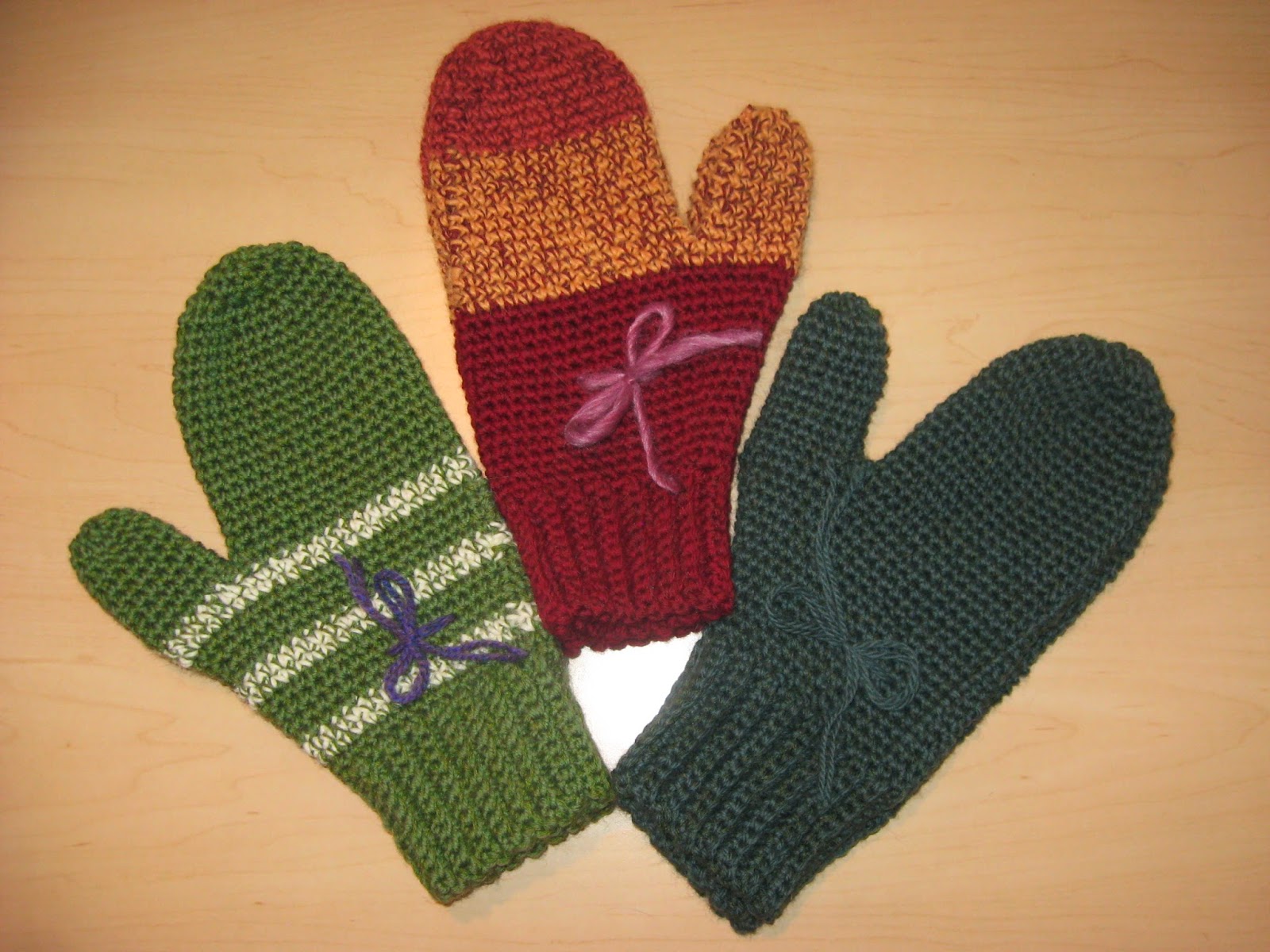
Thanks, everybody, for inspiring me to get cracking again. Here are mittens made from sock yarn donated by Elizabeth D's friend, combined with worsted from another source. I find that one strand of the sock weight combined with worsted makes for an interesting tweedy effect while beefing up thickness and warmth. And don't worry--those excruciatingly mismatched bows are simply ties to hold the pairs together!
Saturday, May 31, 2014
Socks, big and small
Like Elizabeth D. I am psyched for knitting a bunch of baby socks during the sunny month of June. It is going to be fun seeing how many pair I can get out of a skein of regular fingering-weight or dk-weight wool. Last night I cast on for a pair with some leftover Opal sock yarn I had on hand.
When knitting baby socks especially, I have learned the hard way that a flexible top edge is essential. Remember, baby ankles and calves are proportionately chubbier in relation to their feet than on older children, and no baby will be happy with ribbing that hugs the leg too tightly, no matter how perfectly proportioned the sock may look. After my first failure, I researched the topic thoroughly, and I found out that the best way to ensure a stretchy top row is to cast on slowly and carefully. I use the regular long-tail cast-on but I pause and stretch my stitches slightly on the right-hand needle every 3 to 4 stitches. The difference is significant.
 For this sock, I cast on 36 stitches on a size 1 circular (I like to knit socks Magic-Loop style). The 1/1 ribbing took about 6 rounds before I switched to stockinette. I should have a couple more done by the end of the weekend.
 Another pair that went fast was this one, intended for a teenager, knitted in KnitPicks Swish DK. I cast on 40 sts on a size 3 circular. I used leftovers from 2 different skeins but I think one whole skein would work for a pair of approximately the same size.
When knitting baby socks especially, I have learned the hard way that a flexible top edge is essential. Remember, baby ankles and calves are proportionately chubbier in relation to their feet than on older children, and no baby will be happy with ribbing that hugs the leg too tightly, no matter how perfectly proportioned the sock may look. After my first failure, I researched the topic thoroughly, and I found out that the best way to ensure a stretchy top row is to cast on slowly and carefully. I use the regular long-tail cast-on but I pause and stretch my stitches slightly on the right-hand needle every 3 to 4 stitches. The difference is significant.
 Another pair that went fast was this one, intended for a teenager, knitted in KnitPicks Swish DK. I cast on 40 sts on a size 3 circular. I used leftovers from 2 different skeins but I think one whole skein would work for a pair of approximately the same size.
Friday, May 30, 2014
June Baby Shower: Socks
By now you should know about the June Baby Shower - a quickie campaign to collect wool hats and socks for babies in Kabul. Details are here on the A4A web page.
Socks should be of a size to fit newborns to age 1 year -- a minimum foot length of 2.5 (6.3 cm) inches and a maximum length of about 4 inches (10 cm). I have a list of patterns I am checking out, but I will not be recommending any until I have tested them myself. Here is the first on the list, and it is a good one:
.JPG)
This is Susan B. Anderson's Jelly Bean sock, a free pattern for worsted weight yarn, available here. (Scroll to the bottom of the blog entry to get the pdf.) The ribbing pulls it up nicely so that the leg fits snugly around my thumb, indicating that it will stay on a newborn, but it can stretch out to fit an older baby too. The cuff can be folded over when the baby is very young, or pulled up when he or she is older. I made this sock with Cascade 220 (I think), and I have shown it on a 1-inch grid so you can see the finished size. Make only the smallest size from this pattern; the others are too big. I am planning to knit the feet of all my socks to measure 3.5 to 4 inches from heel to toe so they will fit the baby for longer; these socks are going to some of Kabul's poorest families, and there won't be a drawer full of socks to draw from when the baby grows out of these.
As always, use a yarn that's at least 75% wool. Because babies this age don't walk in shoes, the socks can be made with a softer yarn than usually would be recommended for socks.
Making this sock was a lot of fun and took very little time (you cast on just 28 stitches). I will make the second one tonight and start stacking them up. I may never get to the smaller-gauge yarns -- these worsted weight socks go so quickly that I am going to be able to make a whole bunch for this campaign.
Socks should be of a size to fit newborns to age 1 year -- a minimum foot length of 2.5 (6.3 cm) inches and a maximum length of about 4 inches (10 cm). I have a list of patterns I am checking out, but I will not be recommending any until I have tested them myself. Here is the first on the list, and it is a good one:
This is Susan B. Anderson's Jelly Bean sock, a free pattern for worsted weight yarn, available here. (Scroll to the bottom of the blog entry to get the pdf.) The ribbing pulls it up nicely so that the leg fits snugly around my thumb, indicating that it will stay on a newborn, but it can stretch out to fit an older baby too. The cuff can be folded over when the baby is very young, or pulled up when he or she is older. I made this sock with Cascade 220 (I think), and I have shown it on a 1-inch grid so you can see the finished size. Make only the smallest size from this pattern; the others are too big. I am planning to knit the feet of all my socks to measure 3.5 to 4 inches from heel to toe so they will fit the baby for longer; these socks are going to some of Kabul's poorest families, and there won't be a drawer full of socks to draw from when the baby grows out of these.
As always, use a yarn that's at least 75% wool. Because babies this age don't walk in shoes, the socks can be made with a softer yarn than usually would be recommended for socks.
Making this sock was a lot of fun and took very little time (you cast on just 28 stitches). I will make the second one tonight and start stacking them up. I may never get to the smaller-gauge yarns -- these worsted weight socks go so quickly that I am going to be able to make a whole bunch for this campaign.
Saturday, May 17, 2014
Summer knitting season opens in 6 days
Memorial Day weekend traditionally marks the opening of summer in the U.S., and it starts this coming Friday. Here in southeastern Pennsylvania, we've had an unusually cold and snowy winter followed by an unusually chilly and prolonged spring. I fear payback time is soon to be upon us. . .
.JPG) I have learned to knit small things during warm weather, and what could be better? They don't sit on your lap and make you hotter; if they get dirty -- I have never been to an outdoor concert that wasn't muddy or dusty, and there's always the risk of spilled lemonade -- they're easy to wash; and they're easy to toss in a bag and take along.
I have learned to knit small things during warm weather, and what could be better? They don't sit on your lap and make you hotter; if they get dirty -- I have never been to an outdoor concert that wasn't muddy or dusty, and there's always the risk of spilled lemonade -- they're easy to wash; and they're easy to toss in a bag and take along.
This year afghans for Afghans wants to collect as many mittens, socks, and hats as possible.
These are the perfect things to knit on long car trips, at outdoor concerts, sitting on the sidelines at soccer and baseball games, waiting for your kids, or just because you love to knit. (And don't we all?)
I participate in another knitting program, and I have big plans for birthday and holiday presents this year, but I also want to do as much for our friends in Afghanistan as I can. Remember -- you don't have to knit more than anyone else for your contribution to count! One pair of mittens is one whole person who's a little more comfortable. Sizes needed are to fit anyone from about age 7 up to adults.
To keep myself on track, I am stating out loud, right here, that I will commit to finishing 5 things for A4A by the end of August. (One mitten only counts as half.) The pair in progress in the picture will be the first.
I will post a list of tried and trusted patterns sometime this week for those who would like that. Feel free to use your favorites, though -- and remember, animal fiber is WAY warmer. Wool socks stay warm when they are wet, and if that's your only pair of socks, that matters.
You can find all the details at the A4A blog; scroll down to find the list:
http://www.afghansforafghans.org/currentcampaign.html
P.S. Crocheters -- just fill in the word "crochet" where I've written "knit." We love you too.
I have learned to knit small things during warm weather, and what could be better? They don't sit on your lap and make you hotter; if they get dirty -- I have never been to an outdoor concert that wasn't muddy or dusty, and there's always the risk of spilled lemonade -- they're easy to wash; and they're easy to toss in a bag and take along.This year afghans for Afghans wants to collect as many mittens, socks, and hats as possible.
These are the perfect things to knit on long car trips, at outdoor concerts, sitting on the sidelines at soccer and baseball games, waiting for your kids, or just because you love to knit. (And don't we all?)
I participate in another knitting program, and I have big plans for birthday and holiday presents this year, but I also want to do as much for our friends in Afghanistan as I can. Remember -- you don't have to knit more than anyone else for your contribution to count! One pair of mittens is one whole person who's a little more comfortable. Sizes needed are to fit anyone from about age 7 up to adults.
To keep myself on track, I am stating out loud, right here, that I will commit to finishing 5 things for A4A by the end of August. (One mitten only counts as half.) The pair in progress in the picture will be the first.
I will post a list of tried and trusted patterns sometime this week for those who would like that. Feel free to use your favorites, though -- and remember, animal fiber is WAY warmer. Wool socks stay warm when they are wet, and if that's your only pair of socks, that matters.
You can find all the details at the A4A blog; scroll down to find the list:
http://www.afghansforafghans.org/currentcampaign.html
P.S. Crocheters -- just fill in the word "crochet" where I've written "knit." We love you too.
Wednesday, May 7, 2014
Mailed Yesterday
A member of my church knitting group and I decided to do some charity knitting during Lent, and these are the results: 3 pairs of socks and 3 pairs of mittens.

They should be arriving at A4A HQ later this week.
They should be arriving at A4A HQ later this week.
Subscribe to:
Posts (Atom)
